First Aid – What Does the Law Say?
First Aid – What Does the Law Say?
First Aid - Occupational Safety and Health Act
The Work Environment Act is fundamental and aims to prevent accidents and occupational illnesses. The Act is also important for ensuring that a good work environment is maintained in general. The Work Environment Act also describes measures that a workplace should take to maintain essential functions in the event of accidents or illness (AFS 1999:07).
- Measures that must be taken to ensure that the injured or ill person receives medical care as quickly as possible
- Measures to be taken immediately in the event of an accident or illness to maintain and restore vital bodily functions on the spot, as well as to prevent further injury.
- Measures that must be taken to prevent further injury following, for example, a splash. Such measures include emergency showers and eye wash stations.
CPR and First Aid Training Requirements
Equipment
All workplaces must be equipped with appropriate first-aid supplies that are tailored to the risks associated with the specific operation. The supplies must be easily accessible and labeled with signs so that they are easy to spot.
Knowledge
Emergency Preparedness
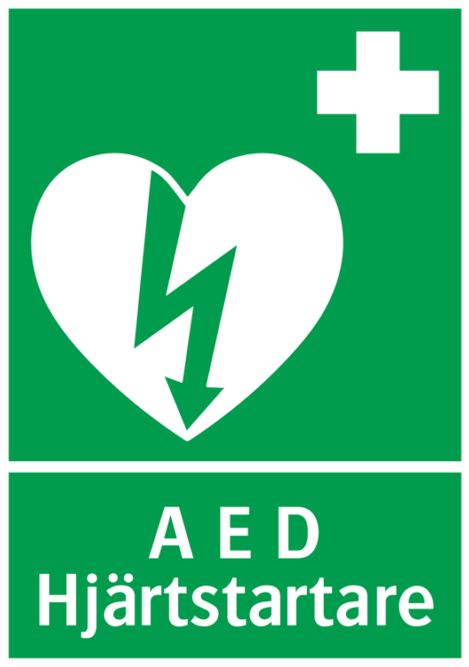
Requirements for defibrillators?
Every year, approximately 10,000 people suffer cardiac arrest outside of hospitals in Sweden. Of these, only 5% survive. If an AED is available and CPR can be started within 3 minutes, the survival rate increases to 70%, compared to the 5% who survive without it. Below is information about our most common AED, the Lifepak CR2, which is available for rent or purchase.
There is still no legal requirement in Sweden for defibrillators to be available at workplaces or in organizations, but a bill proposed by BFHS (the Swedish Industry Council for Defibrillators) is currently under consideration, which would require defibrillators in buildings with more than 10 residential units.
Lifepak CR2
The LIFEPAK CR2 is an AED featuring the latest technology. It is incredibly user-friendly and has a pediatric mode that allows you to switch to pediatric use with a single push of a button. The LIFEPAK CR2 has a fast defibrillation time that saves crucial seconds in an emergency. It comes with an 8-year warranty and a battery life of 4 years. Easy to mount on the wall with a sleek and modern wall mount.
It is a modern defibrillator that comes with Wi-Fi and 3G, as well as two language options if needed. With the LIFELINK accessory, you—as the person in charge—can receive a notification when the battery and electrodes need to be replaced or if the device has been placed in the wrong location.
Help and Support
The defibrillator should be easily accessible and must always be in working order. We’ll, of course, help you with placement and signage, as well as keeping track of when it’s time for battery replacements and refresher training.
We're always just a phone call away if you have any questions or need help.
Heart-Safe Zone
The standard is designed to ensure that organizations are well-prepared for sudden cardiac arrest by providing recommendations for training, placement, information, and maintenance of the defibrillator. We help you meet the requirements for a “heart-safe zone,” and the package includes a framed certificate, stickers, and a digital banner for use on your website or in email signatures, for example.
BFHS
As part of our quality assurance process, we are, of course, members of BFHS (the Swedish Industry Council for Defibrillators). The Industry Council is a supplier- and brand-independent non-profit association for defibrillators and public education, and works to improve survival rates in cases of cardiac arrest.